
Picasso vandalizing . . .Really?
Sorry, I am all for helping the suffering but defacing great works of art does nothing to help. I struggle with graffiti as art. By that I mean "tagging", or spraying your stylized initials of symbols on everything and anything. Not, the great graffiti art we have seen since the days of cave painting. Tagging the modern graffiti are appears more like a juvenile cry of "look at me" than meaningful expression. Talk me down here. But, this little act makes it even harder for me to appreciate the current movement in graffiti.
http://www.theoaklandpress.com/articles/2013/01/09/entertainment/doc50ed6fd9745a2992400738.txt
Wednesday, January 9, 2013

Wednesday, October 10, 2012
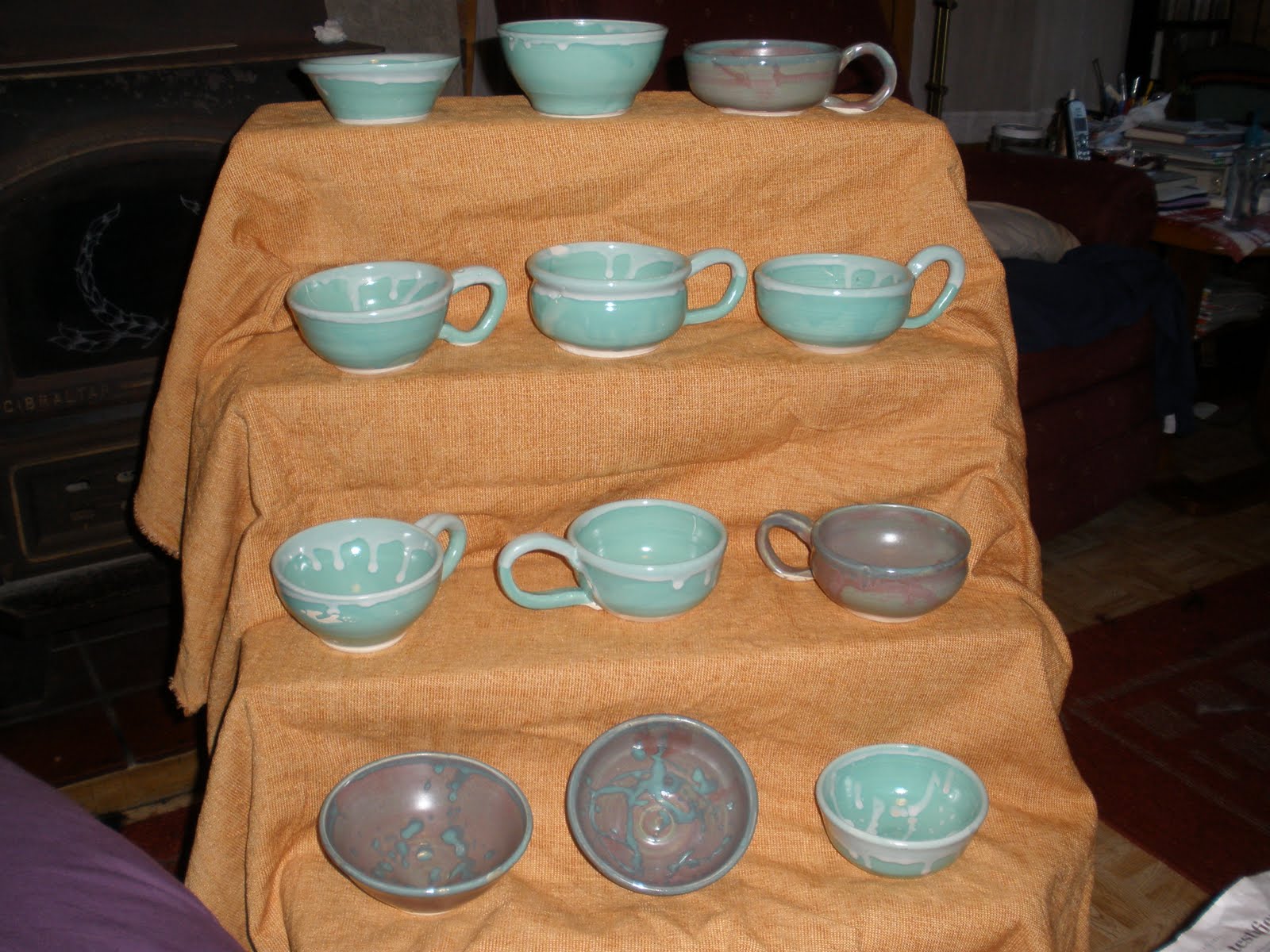
Kiln opened . . new goodies.


These last pics are with a soda bottle (beer bottle size) for size compairison. The goblets are basically "medium" sized. The golden brown mug is "large" and the other mugs are "mediums".
 The golden brown mug is "large" and the other mugs are "mediums".
 Thursday, October 4, 2012

Samuel Miller, Emily Moulton, 1852 from the Currier Museum
"Some portrait painters’ lives remain a mystery, though their works still survive. Samuel Miller, (American c. 1807-1853) painted an image of Emily Moulton (1852). (We know some details about Emily, the sitter, because the painting remained in her family until it came to the Currier.) An inscription on the back of the painting reads: "Painted in 1852 by Mr. Miller who lived on the south corner of Pearl and Bartlett Streets, Charlestown, Mass., USA". Records from 1852 list Samuel Miller as a portrait painter living in Charlestown, but beyond that there was no trace of him. Thus, it was assumed that Miller was an itinerant painter who never stayed anywhere long enough to be documented and perhaps died young. However, a Boston historian has discovered Miller’s death certificate showing that the artist was born in Boston around 1806 and died in Charlestown in 1853. He appears to have specialized in full-length portraits of children, often shown with pets and flowers, similar to folk painting, with the use of flat areas of bright color with a tendency toward simplification. Moreover, a number of works attributed to Miller because of their stylistic similarities to Emily Moulton, can now be dated with some accuracy. One point remains puzzling…if this is Emily, as family tradition maintained, she would have been 18 when Miller painted this portrait. Does she look 18 to you? Clearly the sitter here is younger than eighteen, raising several questions: Whether the portrait in fact represents one of the younger Moulton daughters, whether it depicts someone else entirely, or whether the work could be a copy of an earlier image of Emily.
Itinerant painters did not have the training or the established following that portrait artists in larger cities enjoyed. Some learned the trade as apprentices; others were self-taught and copied the conventions of portraiture from engravings of European portraits. Most itinerant painters had little training or were self-taught. They relied on native ability and the skills they had acquired as sign, house or coach painters to depict what they saw. Despite their lack of formal training, they often captured the essence of the sitter’s personality."
From this great page at the Currier Website:
http://curriculum.currier.org/portraiture/itinerant.html#DanielWebster
Thursday, June 21, 2012


Quick factiod . . .
Heard on local public radio. Arts and Culture contribute 4% of the island's economy. That is nearly twice the state average and miles a head of others. I am lucky to live here. . . . . . (I do think the number is low, for I visited here before I lived here for cultural events. I am sure most come for the beach, but many come for the great art and cultural resources we have here. This contributes to our tourism sector.)
Monday, January 23, 2012


Wednesday, January 18, 2012
Renowned art museum, Manchester, NH???

The dust is clear and political caravans have long since left the Granite State for South Carolina and beyond. I thought it would be fun to point out that there is more to New Hampshire than skiing and a quad-annual circus of a political primary. Manchester is home to an internationally renowned art museum: the Currier Museum of Art. I am planning a trip off the island and up north to the Currier at the end of the month. My second in recent years. This museum in a little treasure tucked away safely on a side street of a sleepy Northern New England city.
From their website: "The Currier features European and American paintings, decorative arts, photographs and sculpture, including works by Picasso, Monet, O'Keeffe, Wyeth, and LeWitt with exhibitions, tours, and programs year-round. The museum also offers tours of the Frank Lloyd Wright-designed Zimmerman House."
There are several goodies that are of interest and have me excited to return,
1.) The Henry Melville Fuller Paperweight Collection: 330 high quality glass paperweights from great glasshouses and artist in Europe and the United States.
2.) A fantastic ceramics collection including the works of Mary and Edwin Scheier.
3.)And finally two works by a true itinerant. The Portrait of Mark, Abigail and Lois Susan Demeritt (1835 watercolor, ink and graphite on paper - shown above) and a drawing of Bartholomew Van Dame (1836 watercolor, ink and graphite on paper) both by itinerant Joseph H. Davis. Davis painted more than 150 watercolor portraits of prosperous middle-class men, women, and children who lived along the Maine-New Hampshire border.
I plan to blog more about the Scheiers and Joseph H. Davis. folk pottery and a identified itinerant, how could I not. I may also at some time talk about the Medieval works at the Currier. However, for now I will say, visit the Currier and if you have been there, head back!
Sunday, December 11, 2011

Wednesday, December 7, 2011
7500 Years of Pottery

This article is a little old. But, I found it interesting. Considering current world events, Iran is often in discussion. The city of Lalejin in Hamedan Province, has a 7500 year-old pottery tradition. I know this is my "art blog", but it is hard to think about what could happen to this wonderful cultural center if the powers that be decide they need "shock-and-awe". Hopefully, we can live in peace with Iran, and someday art and culture can flow freely between our nations.
http://www.eturbonews.com/11646/leading-ceramic-centers-iran
Thursday, December 1, 2011
Martha's Vineyard Museum Island Faces portrait contest

This is a portrait of Captain Thomas Worth (1793-1824) of Edgartown Mass, by an unknown Itinerant Artist. It is owned by the Martha's Vineyard Museum. The Museum is a great little historical museum with many interesting artifacts from Martha's Vineyard history. Plus, some great portraits from the 19th century. If you visit the Vineyard, it is a great place to take a break from the beach.
The museum is running a portrait contest. "Island Faces" It is open to anyone over 15 years old, but the subject must be an island resident. There are plenty of notable island residents to choose from.
I think this a great contest that will become very popular. So, please enter or tell artist you know to enter.
Info and details are here:
http://mvmuseum.org/portraitcontest.php
The Martha's Vineyard Times covered it here:
http://www.mvtimes.com/marthas-vineyard/article.php?id=8284
(In case you didn't guess. I am currently a Vineyard resident)
Tuesday, November 29, 2011
Strange tales and the portrait Marie Laveau

Well, like so many I use Facebook. Also, like many I have many people on my "Friends" list. Recently I had a odd experience. I had a FB friend who I did not know. I wasn't sure how she got there. I noticed that her profile pic was this really cool portrait of a woman with a head scarf or turban* and a shawl. I wondered if this was a contemporary portrait of her do in the style of a early period or a antique portrait. It appeared to be 19th century in style. Maybe the work of an American Itinerant Painter! So rather than pepper her with a million questions at once I posted to ask her if she knew who had painter the picture. She responded a "nameless" painter. I was very excited to see was was then most likely the work of a Itinerant. I told her this. She then told me it was a picture of Marie Laveau and people said she looked like Marie. I knew that Laveau was was a practitioner of Voodoo in New Orleans. I right way searched for the painting on line to learn more about it. Plenty of info was found on Wikipedia.*
Laveau was born in 1782 and died in 1881. A very long life for anyone in the 19th century, never mind for a person of mixed race in the south. She and her daughter, Marie Laveau II, had a large multi-racial following. Still today visitors place marks on her alleged crypt for a voodoo wish.
But, the portrait has a interesting history. It is not a portrait by a "nameless" painter. It is attributed to none other that George Catlin, famed painter of the American West and Native people in the mid-1800's. But, this is not the painting! The portrait we have today is by Frank Schneider and was painter by him around 1920. It is "after" or copied from the original that is said to be by George Catlin. Apparently the original is lost. The copy belongs to the Louisiana State Museum. The painting I have posted is after Schneider's by a person called Smerdis Smerdis of Tlon , who posted it to Wikipedia and released it into the public domain. Schneider's version is copyrighted. When dealing with the copyrighted picture of a Voodoo priestess still respected by practitioners today, I try to play it safe.
However, I can find little information about the Catlin painting. They would of been contemporaries. It is easy to image that Catlin would have visited the Port of New Orleans on his trip in 1830 when he accompanied General William Clark on a diplomatic mission up the Mississippi River into Native American territory or on later trips into the American West. So, where does the information that the original was by Catlin. I have found not refrences to it in on-line Catlin websites. Why would a painting of a well know New Orleans figure done by a important American painting dispear. Is there proof it ever existed? Was Schneider working from a orignal that was only attributive to Catlin by local ledgend? Or, is it possible the exsistence of the orginal is only legend? Does anyone know more about this? I would love to learn more.
This is a strange tale, fitting for a portrait of a voodoo priestess. Strangely enough the young lady "disappeared" from my FB "friends list" after introducing me to this wonderful portrait.
I will post more if I find out anything . . . .
* (Apparently this is called a“tignon.” It was always very fancy, made of colorful material and considered a fashion accessory. She usually wore it with seven knotted points sitting up like a crown. This information is from a poster at Yahoo Answers)
**(Please don't tell my students I used Wikipedia. I often explain how it is not a scholarly or primary source, and can be very unreliable. But, for this it seem like a reasonable place to look.)
Sunday, November 27, 2011
ipad love or kicking it "old skool"

Was amazed by ipad, with stylus, and "Paint" app. Tried them in a store. Sketched away. Thought this could replace my always present sketch book. Then after the thrill died down, I thought: this is nothing I can't do with dry medium and paper then scan into "Gimp". Also, the apps seem limited to a max of four layers and appear to save in their own format not portable to other Graphics software. Think I am going to stick with "old skool".
This is mostly a visual blog - so I am going to throw up this doodle on made to past time on the ferry boat today.
Wednesday, November 23, 2011
Maiolica - Traditional and Non-traditional

A traditional design with Ships on Terra Cotta and a Non-Traditional Sailor Tattoo Design I call "First Mate" This is my second stab at the "First Mate"


Maiolica - Some very traditional Old World - some not so traditional with Sailor Tattoo Designs.

Mermaid - a sailor's dream!


Sailor Tattoo Star

Very Traditional!
Mermaid - a sailor's dream!

Sailor Tattoo Star

Very Traditional!
Beanpot


Traditional New England Hand Throw Beanpot w/ very non-traditional design. The clay body has specks of Mag. Oxide that make the brown speckles. I fired the lid in place, dry. The Oxide must have fluxed fusing the lid to the body. I tried every trick I knew to dislodge it and it would not budge. I have given up and decided it would be a great doorstop. Then, I picked it up by the loop and it came free and clear. - (I already have request for more of this form.)
Itinerant Potrait Myth?

I found this recently:
"Myth # 66: In the winter, itinerant portrait painters would work ahead, painting canvases with bodies and backgrounds, but no heads, so that come summer, they would have only to fill in the subject’s head."
Found at
http://historymyths.wordpress.com/2011/10/15/myth-66-in-the-winter-itinerant-portrait-painters-would-work-ahead-painting-canvases-with-bodies-and-backgrounds-but-no-heads-so-that-come-summer-they-would-have-only-to-fill-in-the-subjects/#comment-771
They conitue with:
"Such a good idea! Stay home during the winter months and paint a stock of canvases with bodies and backgrounds, then ride out in the warmer months to find clients who could select a body and pay to have their head painted on it. A real time saver for both artist and sitter, right?
But there is no evidence for it. No artist or sitter mentioned in dairies or other written records that this practice occurred. No unfinished, headless portrait painted by an early American folk artist has been discovered in an attic or storage shed. (And the few unfinished portraits that do survive inevitably include heads.) No physical evidence, like overlapping paint layers at the neck or head, has been detected on existing portraits. Nonetheless, museum guides say that someone in the group inevitably asks about this whenever folk art portraits come into view.
It makes sense to us today, and it seems to explain the similarities in the clothing and backgrounds of some American folk art portraits. However, in portrait painting, artists typically start with the most important feature—the head—and work the rest around that.
Because there are many examples of portraits that are highly similar in body and background, the myth spread. Scholars such as E. C. Pennington (Lessons in Likeness, 2011) and museums like the American Folk Art Museum, Cooperstown, the Columbus Museum, and Colonial Williamsburg point out the lack of evidence for this practice. "
What the next thin they are going to say is the itinerants didn't also paint signs and other commercial jobs when they needed money!
I do have a less reactionary response.
My response:
There is a painting at the Fearing Tavern Museum in Wareham Mass that the sitters head is very oddly placed her a body. It has been suggested this is a stock painting finished with the sitters head. I will attempt to photograph it, but it may take sometime. The museum is operated by the local historical society and only open on Saturday in August. It was this painting that help fuel my interest in these early American Artist.
Additionally another poster said this:
"At Hammond-Harwood House in Annapolis, MD, we have a portrait by Robert Edge Pine that shows that the head and body were painted separately. You can clearly see a square where the layer of canvas containing the head seems to have been glued on top of the layer showing the body. I don’t think that Pine painted a generic body and then put a specific face on it, but I haven’t been able to find a definite reason for the technique he used. Someday I hope to have time to research it…"
So there you have it! What do you think?
I am posting a portrait of Daniel Webster done by a unnamed Itinerant.
Friday, August 26, 2011
I am really happy with these'


I like how these came out. The little Ginger Jar in browns is my favorite. All where from a batch thrown in late July and August. The mug and the Creamer/Sugar are dark stoneware clay fired in oxidation to Cone 6 - High Fire. The Ginger Jar is white stoneware clay from the same firing.


Saturday, August 20, 2011

Friday, July 9, 2010
Monday, September 28, 2009

Subscribe to:
Posts (Atom)